
Life game
It was in 1970 that Martin Gardner introduced J.H. Conway’s “Life game” in Scientific American, an American science magazine. The “Life game” is not a conventional game that requires continuous input from a player. Instead, it is a zero-player game in which, once the initial state is set, all subsequent states are automatically determined according to a set of rules. For quite some time after the Life game was introduced, it became extremely popular on PCs and computer terminals around the world.
Rules of the Life game
Place several stones (life) on the intersections or cells of a grid. Each cell has one of two states: alive (1) or dead (0), and the eight cells surrounding it are considered its neighbors.
Each life form continues to evolve according to the simple rules described below.
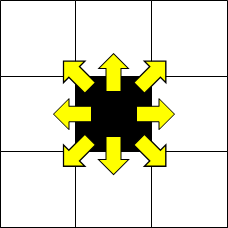
- A live cell with 0–1 live neighbors → dies (underpopulation)
- A live cell with 2–3 live neighbors → survives
- A live cell with 4 or more live neighbors → dies (overpopulation)
- A dead cell with exactly 3 live neighbors → becomes alive (birth)
All changes in cell states are applied simultaneously in each generation.
The “Life game” is a simple game that can be enjoyed simply by observing it, but its patterns of change are surprisingly rich and varied, making it fascinating to watch.
The “Life game” can also use a method in which a cell moving beyond one edge of the map reappears on the opposite side. This is one way of approximating the infinite grid envisioned by Conway on a finite screen. Some scientists have suggested that our real three-dimensional universe might also be connected at its boundaries in a similar way. This idea is known as the “toroidal (Torus) model of the universe.”