
Charging by Friction
Matter is made up of extremely small particles called atoms. An atom consists of a positively (+) charged nucleus and negatively (-) charged electrons. A neutral atom has equal amounts of positive and negative charge, so it has no net electric charge.
When two electrically neutral objects are rubbed together, electrons are transferred from one object to the other. The object that gains electrons acquires an excess of negative charge and becomes negatively charged, while the object that loses electrons has a deficit of negative charge and becomes positively charged.
For example, when a plastic comb is used to comb a cat’s fur, electrons are transferred from the fur to the comb. As a result, the comb becomes negatively charged, and the cat’s fur becomes positively charged. The process by which an object acquires an electric charge is called charging, and an object with a net electric charge is called a charged object.
Electrostatic Induction
When a negatively charged plastic rod is brought near an electrically neutral aluminum can, the aluminum can is attracted toward the plastic rod. Why does this happen?
Metals such as aluminum contain many electrons that can move freely. When a negatively charged plastic rod is brought near an aluminum can, the electrons in the can experience a repulsive electric force from the rod and move toward the side farther away from it. As a result, the side of the aluminum can closer to the plastic rod becomes positively charged, while the farther side becomes negatively charged. The resulting net attractive electric force between the aluminum can and the charged rod causes the can to move toward the rod.
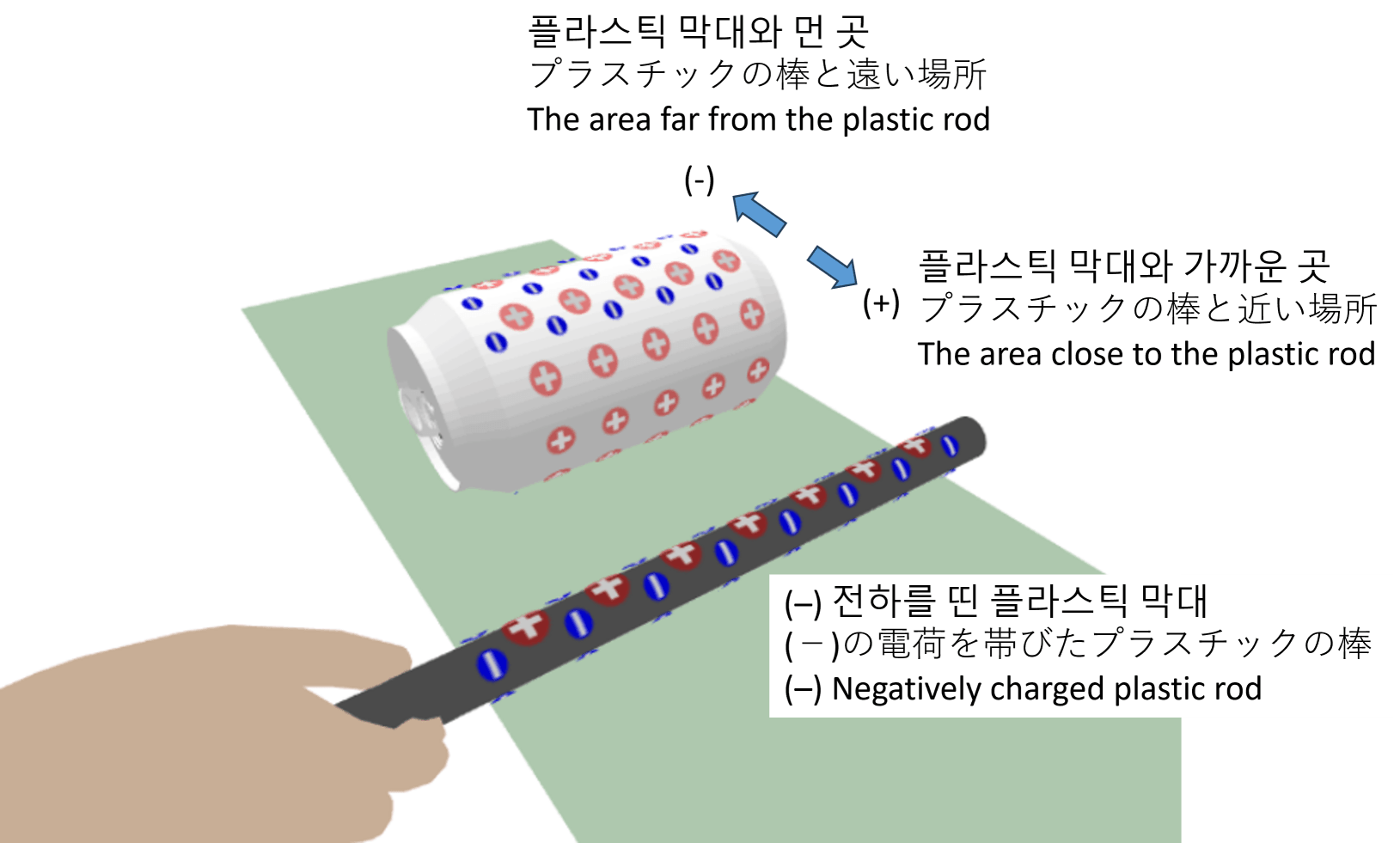
In this way, when a charged object is brought near an electrically neutral metal object, the side closer to the charged object acquires a charge of the opposite sign, while the farther side acquires a charge of the same sign. This redistribution of electric charge is called electrostatic induction.