
- Element symbol mode displays only valence electrons, while atomic structure mode also displays the inner electron shells.
- Chemical bonds are depicted in two dimensions, but real substances can have various three-dimensional structures.
- Atomic sizes, bond lengths, and bond angles differ from their actual values.
- This simulation is a simplified model for understanding chemical bonds and does not accurately represent actual electron transfer or ionic charges.
- The feature that displays element symbols in red is based on typical numbers of bonds and does not determine actual chemical stability.
Chemical Bonds
Many atoms can reach a lower-energy, more stable state by bonding with other atoms.
In this process, many atoms tend to acquire electron configurations similar to those of the noble gases in group 18. A common rule describing this tendency is the octet rule.
Octet Rule
The octet rule (or eight-electron rule) is an empirical rule stating that many atoms tend to acquire an electron configuration with eight electrons in their outermost electron shell when forming chemical bonds.
However, not all atoms follow the octet rule.
- The innermost electron shell can hold a maximum of two electrons. Hydrogen (H) can achieve the same electron configuration as helium (He) by sharing electrons with another atom or gaining one electron. Lithium (Li) can achieve the same electron configuration as helium by losing one electron.
- Some substances, such as boron trifluoride (BF3), have fewer than eight electrons around the central atom.
- Some substances, such as nitric oxide (NO), cannot satisfy the octet rule because they have an odd total number of valence electrons.
- Some substances containing elements from the third period or beyond are represented as having more than eight electrons around the central atom. (Examples: PCl5, SF6, etc.)
Covalent Bonds
A covalent bond is a chemical bond formed when two atoms share one or more pairs of electrons.
Many atoms acquire electron configurations similar to those of noble gases by sharing electrons.
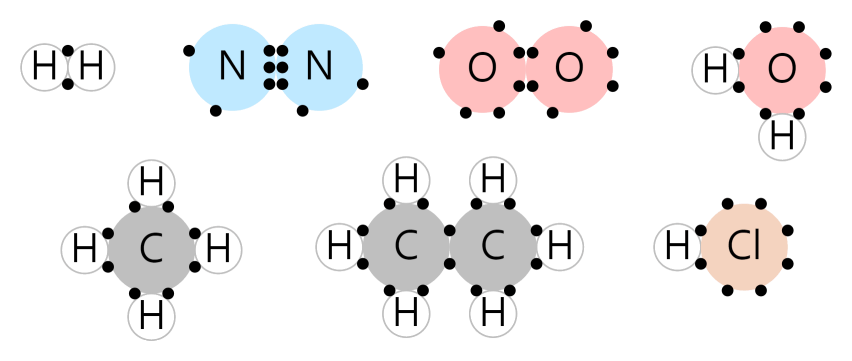
The illustration below shows examples of covalent bonds. The electrons shown between atoms are shared by the two atoms. In covalent bonds that follow the octet rule, counting the electrons around each atom, including the shared electrons, gives two electrons for hydrogen and eight for the other atoms.
Ionic Bonds
An ionic bond is a chemical bond formed by electrostatic attraction between cations and anions.
Many metal atoms tend to lose valence electrons and become cations, while many nonmetal atoms tend to gain electrons and become anions. The ions formed in this way often have electron configurations similar to those of noble gases.
The illustration below is a model explaining ionic bonds. Lithium (Li), sodium (Na), and calcium (Ca) donate valence electrons to other atoms and become cations. The atoms that gain electrons become anions, and electrostatic attraction acts between the cations and anions.
In actual solid ionic substances, many cations and anions are arranged in a regular pattern to form a crystal.
