About this simulation
This simulation allows you to connect and test various neurons.
Inspired by logic circuits, we created three types of neurons: ‘AND’, ‘OR’, and ‘NOT’.
In reality, human Interneurons(association neurons) are much more complexly connected, but this simulation has been simplified to a level that’s easy to understand.
Clicking on a neuron cell body reveals a drag point, allowing you to move the neuron or change the direction of its axon.
- AND neuron (AND circuit)
- Outputs true when all inputs are true.
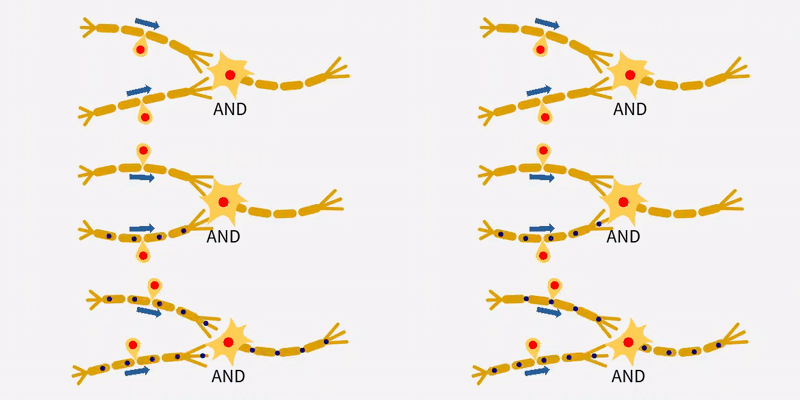
- OR neuron (OR circuit)
- Outputs true if at least one input is true.

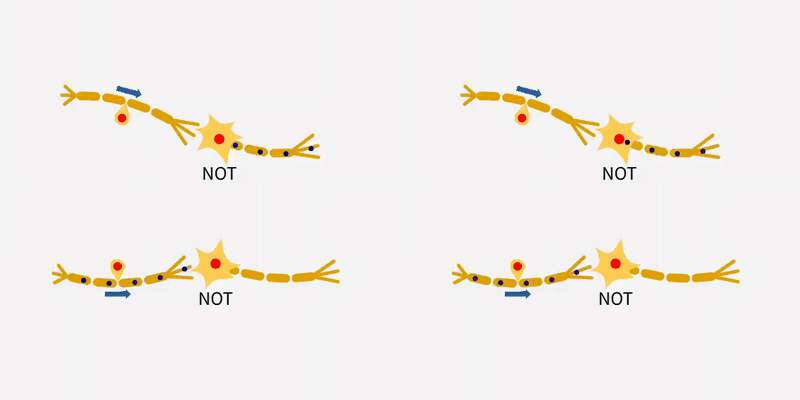
- NOT neuron (NOT circuit)
- Outputs true and false inverted.
nervous system
The nervous system (NS) is the system that allows animals to receive stimuli from their environment and respond to them. The nervous system is composed of nerve cells called neurons.
Generally, neurons consist of a cell body (soma), dendrites, and an axon. The cell body (soma), containing a nucleus and cytoplasm, is where various vital functions occur. The dendrites receive stimuli from other neurons or sensory organs, while the axon transmits stimuli to other neurons or organs.
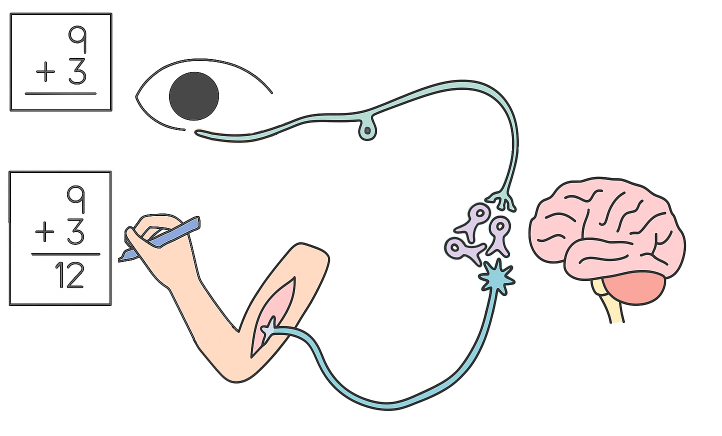
Neurons are classified based on their function: sensory neurons, Interneurons(association neurons), and motor neurons. Sensory neurons form the sensory nerves, interneurons form the central nervous system, and motor neurons form the motor nerves. Sensory neurons receive stimuli from the sense organs and transmit them to interneurons. Interneurons perceive and judge the stimuli and send signals to motor neurons. Motor neurons then relay the signals from interneurons to the response organs. In this way, stimuli are transmitted through neurons, resulting in an appropriate response.
Similarities between the biological nervous system and artificial neural networks
The structure and function of the biological nervous system inspire artificial neural networks. While there are interesting similarities between the two, there are also significant differences.
| biological nervous system | artificial neural networks | |
|---|---|---|
| Signal input | Receive signals from other neurons through dendrites | Accept data from input node |
| Signal processing | Integrates and processes signals received from the cell body (soma) | Process by multiplying and summing the weight values |
| Whether the signal is output | When a certain threshold is exceeded, a signal is transmitted through the axon. | Determine the output through an activation function |
| Signal transmission | Transmit signals to the next neuron through the axon | Pass the output value to the node of the next layer |
| Learning process | Experience changes how neurons connect and process signals. | Weight values are adjusted through learning |
Artificial neural networks are mathematical models that operate based on a simplified structure. While they are far removed from the actual brain’s operation, they mimic its principles and perform useful functions.
Nevertheless, the human nervous system is still far more complex and dynamic than artificial neural networks. It processes thousands of inputs simultaneously, responds over time, and is also influenced by chemical factors.