
Real and Virtual Images
We perceive an object as being at a particular location when light emitted or reflected by that object enters our eyes. However, when the path of light is changed by a mirror or lens, an image may form at a location different from the actual position of the object.
Real image: An image formed when reflected or refracted light rays actually converge at a point. A real image can be projected onto a screen placed at the image location.
Virtual image: An image formed when light rays do not actually converge, but their backward extensions appear to meet at a point. A virtual image cannot be projected onto a screen placed at the apparent image location.
Virtual Images in Convex Mirrors
A convex mirror always produces an upright, virtual image that is smaller than the object, regardless of the object’s position. Because convex mirrors provide a wide field of view, they are commonly used as auxiliary mirrors on vehicles and as security mirrors.
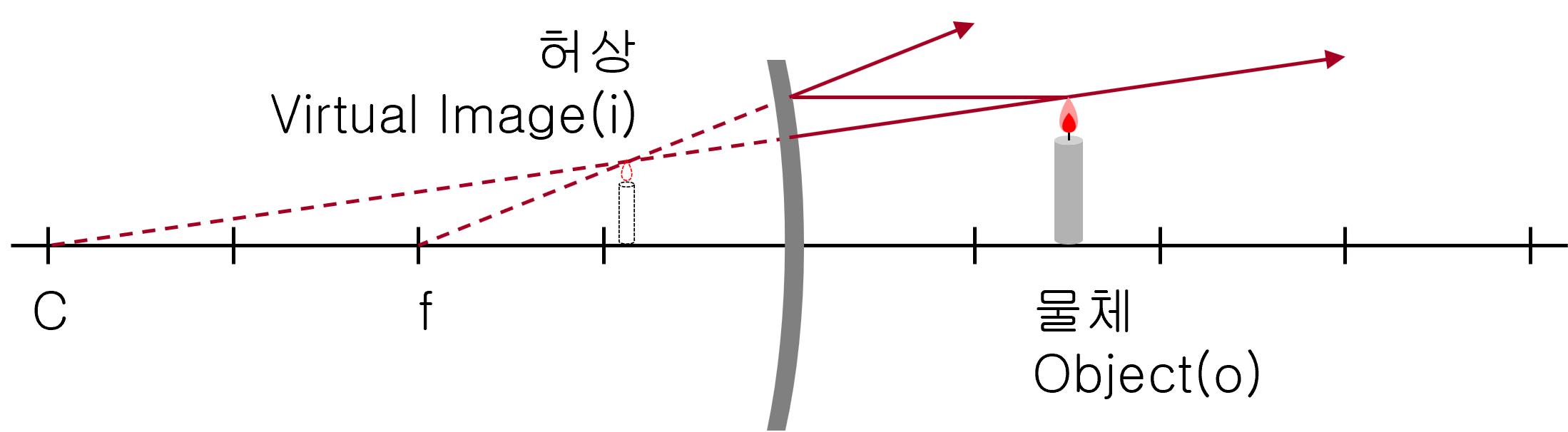
Virtual and Real Images in Concave Mirrors
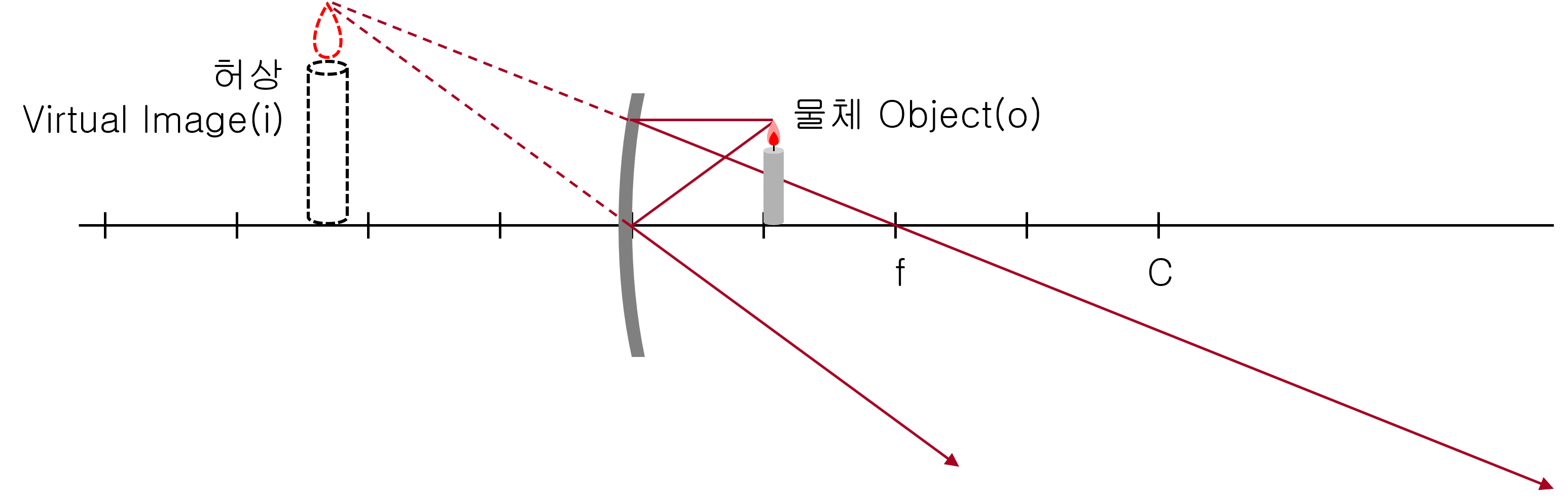
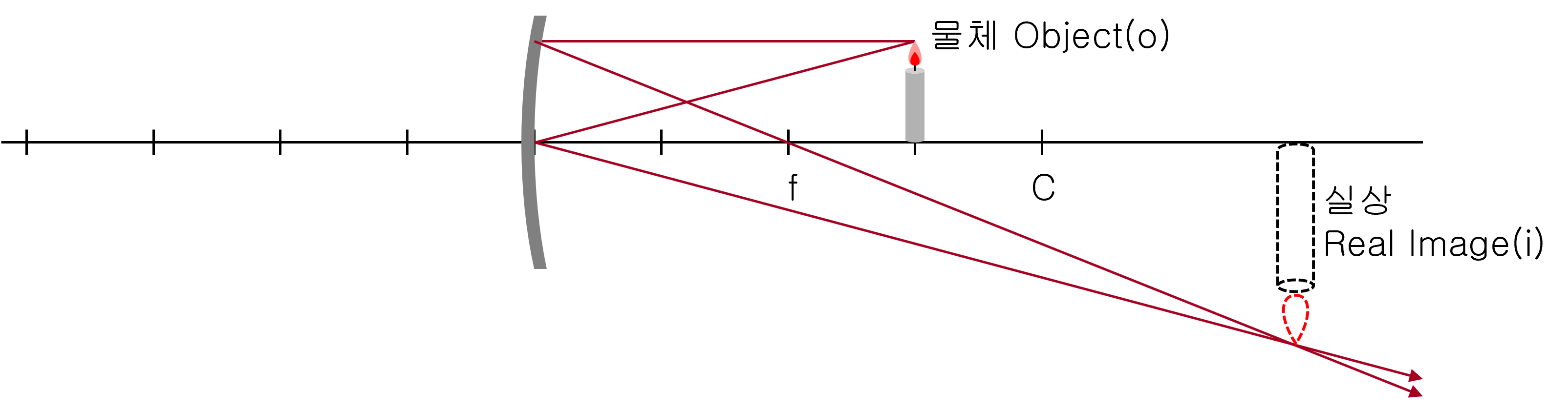
The appearance of an image formed by a concave mirror varies significantly depending on whether the object is located inside or outside the focal length.
When the object is inside the focal length: An enlarged virtual image is formed, and the image is always upright.
When the object is beyond the focal length: A real image is formed, which may be enlarged or reduced depending on the distance between the mirror and the object. The image is always inverted.
When the object is located exactly at the focal point, the reflected rays travel parallel to one another, and the image is considered to be formed at infinity.
The inner surface of a spoon can act as a concave mirror, while its outer surface can act as a convex mirror.
Calculating Image Distance
The following relationship holds between the object distance o, the image distance i, and the focal length f of a mirror. For spherical mirrors, this equation is approximately valid for light rays traveling close to the principal axis.
\[\frac { 1 }{ o } +\frac { 1 }{ i } =\frac { 1 }{ f } =\frac { 2 }{ R } \]
- o: Distance from the mirror to the object. It is positive (+) for a real object.
- i: Distance from the mirror to the image. It is positive (+) for a real image and negative (-) for a virtual image.
- f: Focal length. It is positive (+) for a concave mirror and negative (-) for a convex mirror.
- R: Signed radius of curvature. Its magnitude is approximately twice the focal length.
For a Convex Mirror
- o > 0: Real object
- i < 0: Virtual image (behind the mirror)
- f < 0: Virtual focal point (behind the mirror)
For a Concave Mirror
- o > 0: Real object
- f > 0: Real focal point (in front of the mirror)
- The sign of i depends on the object’s position.
- When o < f: i < 0 (upright virtual image)
- When o = f: The image is formed at infinity.
- When o > f: i > 0 (inverted real image)
Ray Tracing
The position of an image can be determined by tracing the paths of two light rays originating from a single point on the object.
- A ray incident parallel to the principal axis passes through the focal point after reflection from a concave mirror. For a convex mirror, the backward extension of the reflected ray passes through the virtual focal point.
- A ray passing through the focal point of a concave mirror, or directed toward the virtual focal point of a convex mirror, is reflected parallel to the principal axis.
- A ray directed toward the center of curvature strikes the mirror perpendicular to its surface and is reflected back along its original path.
- A ray incident at the vertex of the mirror is reflected according to the law of reflection, with the angle of incidence equal to the angle of reflection.
Calculating Magnification
The size and orientation of an image formed by a mirror can be described using magnification.
\[m=-\frac { i }{ o } \]
- m: Magnification
- i: Image distance from the mirror
- o: Object distance from the mirror
The image characteristics depend on the calculated value of m as follows.
- m > 0: The image is upright.
- m < 0: The image is inverted.
- |m| > 1: The image is larger than the object.
- |m| < 1: The image is smaller than the object.
- |m| = 1: The image is the same size as the object.