
What is a covalent bond?
A covalent bond is a chemical bond formed when two atoms share electron pairs. Covalent bonds generally form between nonmetal atoms, and electrons are typically shared in pairs.
An electron pair shared between two atoms is called a bonding pair. A pair of valence electrons that belongs to one atom and does not participate in bonding is called a lone pair (nonbonding pair).
Depending on the number of electron pairs shared between two atoms, covalent bonds are classified as single, double, or triple bonds.
Single Bond
Two atoms share one electron pair (two electrons).
A single line between the atoms represents the bond.
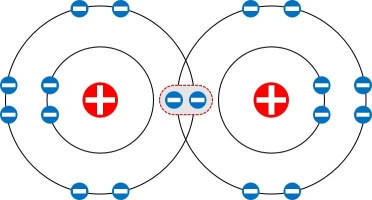
F-F (fluorine molecule)
Double Bond
Two atoms share two electron pairs (four electrons).
Two lines between the atoms represent the bond.
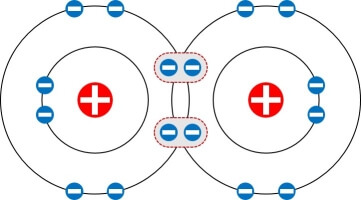
O=O (oxygen molecule)
Triple Bond
Two atoms share three electron pairs (six electrons).
Three lines between the atoms represent the bond.
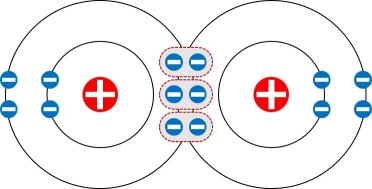
N≡N (nitrogen molecule)
Limitations of the simulation model
This simulation uses a simplified model of atoms and electrons to help explain how covalent bonds work. It differs from actual electron distributions, atomic sizes, bond lengths, and three-dimensional molecular structures.